I Accidentally Turned a Voice Recorder into an MP3 Player (And It Was Kind of Perfect)
I was tinkering with an Aiworth E36 digital voice recorder the other night. Nothing serious. Just one of those “what does this thing actually do?” moments.
The documenation and packaging market it as a Professional Digital Audio Recorder, and, well, it records WAV and MP3 files. But, that got me thinking…
If this little device can record an MP3 and has the ability to play back recordings, it can probably play any MP3 file so long as the bitrate doesn’t exceed the capablilites of the device.
So I did what any rational adult with access to a file system would do in this scenario and I dumped some music onto it. 😉
Then some basic testing revealed that it worked!
Not “sort of” worked. Not “glitchy demo mode” worked.
It just worked. 👍
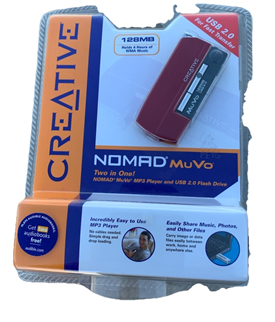 Suddenly this little voice recorder was functioning like the USB-stick MP3 player I carried around in 2005, the exact kind that looked like a flash drive with a tiny screen and held a staggering 256MB of music. The one I had was identical to the classic silver USB stick style you still see floating around eBay.
Back then, 256MB felt revolutionary. That was roughly:
- 60 songs at 128 kbps\
- Maybe three albums if you were feeling fancy\
- A carefully curated playlist you knew by heart
Now this little recorder has 16GB onboard. No streaming. No login. No app. No notifications. Just files.
And somehow… that felt refreshing.
The Experiment#
Of course, I couldn’t just leave it there. I had to understand how it actually worked.
So I started experimenting with folder structures.
At first, I created something logical:
/MUSIC
   /Genre1
   /Genre2
Nothing showed up.
Interesting.
Then I noticed two directories on the device:
/RECORD
/MUSIC.LIB
That .LIB extension caught my attention.
Inside were strings like:
- ALLSONG\
- ALBUM\
- ARTIST\
- GENRE
That wasn’t a music folder. That was a database.
The device builds its own music index.
Now things got interesting.
The Quirks of Minimal Firmware#
After more testing, here’s what I learned:
- The device only scans
/RECORD - It does not properly recurse into nested folders
- It builds a music index into
MUSIC.LIB - Once a recording exists, playback behavior changes
- Subfolders become unreliable
- Root-level files inside
/RECORDalways work
If I placed MP3 files directly into:
/RECORD
Everything showed up.
If I placed them in:
/RECORD/MUSIC/Test1
They vanished from view.
This is not a modern file browser. This is minimalist embedded firmware with hardcoded assumptions.
And honestly? That’s what makes it fascinating.
This device was built to record voice first. Music playback is
secondary. The firmware likely just scans /RECORD, builds an index,
and calls it a day.
No recursive traversal. No metadata wizardry. No dynamic library logic.
Just list files in this folder. If extension = MP3, add to index.
And I love that!
Why It Feels Good#

There’s something calming about a device this simple.
It doesn’t:
- Sync to the cloud
- Track listening history
- Suggest new music
- Update itself overnight
- Send notifications
It just plays what you put on it.
Back in 2005, you curated your music because you had to. Storage was scarce. Every song earned its place.
Today, we stream from catalogs of 100 million tracks and somehow feel less connected to what we’re hearing.
This little recorder accidentally forced me back into intentional listening.
The Sound Quality Surprise#
For what it’s worth, it sounds… good.
Genuinely good.
Stereo playback is clean. No weird artifacts. No distortion. Just simple DAC → headphone output.
MP3 decoding has been a solved problem for two decades. Even inexpensive chips handle it flawlessly now.
Recording quality? That’s a different pipeline.
But playback? Solid.
The Firmware Rabbit Hole#
Naturally, I wondered:
Can I customize the firmware?
I dug into that possibility. Unfortunately, Aiworth’s site appears to be gone as of 2020. No firmware downloads. No update utilities. No SDK. Just YouTube videos of people popping the back cover off and revealing a LiPo battery.
Classic budget OEM rebrand situation.
The firmware version on mine reads: V2 19.04.25
Which probably means it hasn’t been touched since 2019.
And honestly? It doesn’t need to be.
The quirks are part of the charm.
No SD Card… Yet#
For now, I’ve only tested the onboard 16GB storage. I haven’t even tried adding an SD card. There’s something appealing about keeping this experiment intentionally constrained.
It mirrors that 256MB stick from years ago.
Limited space changes behavior.
You curate differently.
You listen differently.
What I Learned#
Sometimes older design philosophies are accidentally better.
- Simple file systems
- Deterministic behavior
- No background services
- No ecosystem lock-in
- No forced updates
This isn’t nostalgia talking.
It’s a reminder that single-purpose devices can be deeply satisfying.
In a world of infinite streaming, I accidentally built a dedicated, distraction-free MP3 player out of a voice recorder.
And honestly?
It’s kind of perfect.